
UPSC / JPSC / JSSC
Sunlight for Sale: How Reflect Orbital and Skyroot Plan to Reflect Sunlight from Space
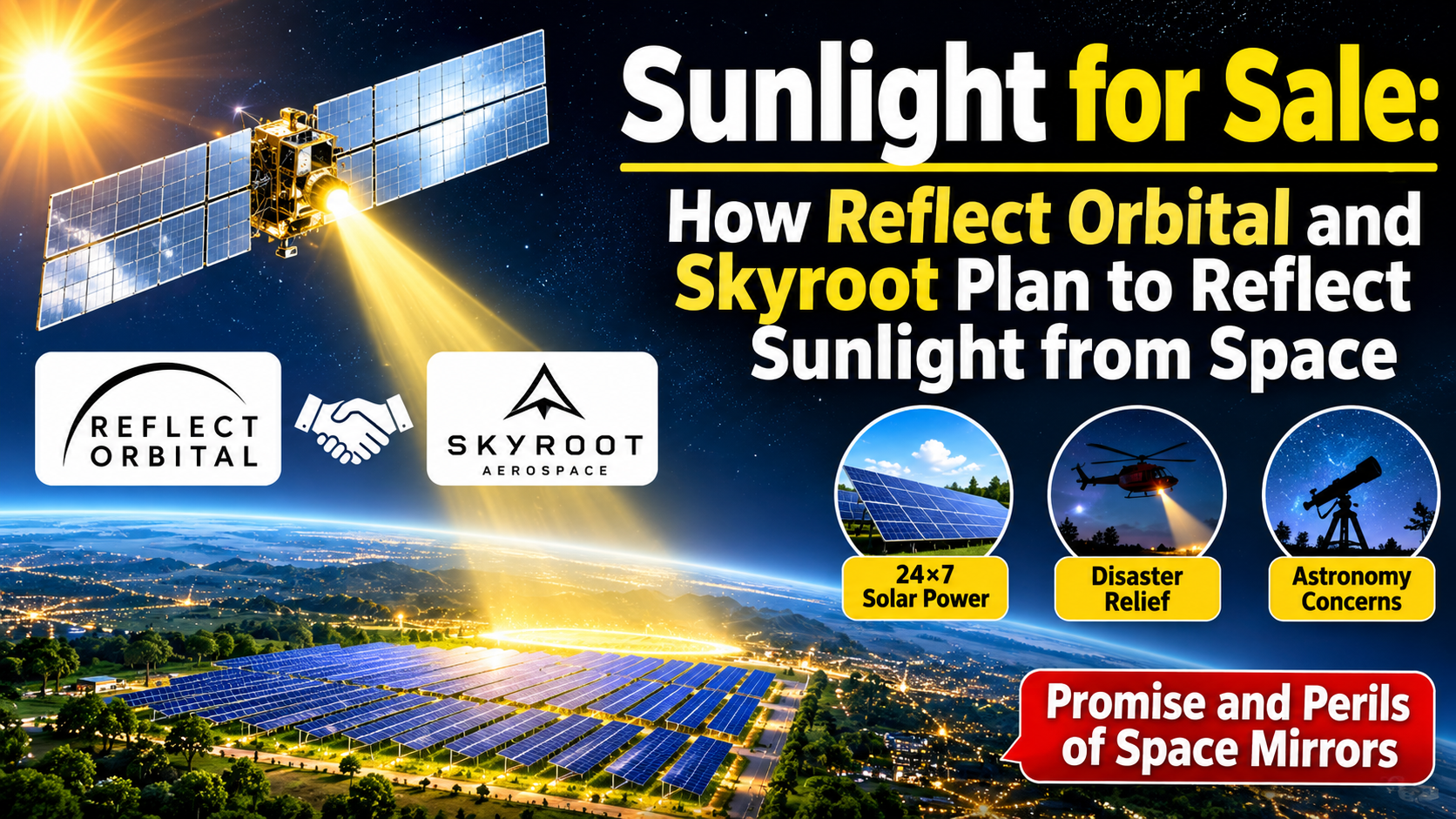
Imagine looking up at the night sky and seeing an area of the Earth illuminated not by the Moon or streetlights, but by sunlight reflected from a giant mirror orbiting hundreds of kilometres above the planet. This is the idea behind Reflect Orbital, a California-based space technology startup developing orbital mirrors to direct sunlight towards selected locations on Earth after sunset.
The project gained an important India connection on 14 October 2026, when Reflect Orbital announced that it had purchased two dedicated launch services from India’s private space company, Skyroot Aerospace. The planned missions will use Skyroot’s Vikram-1 and its in-development Vikram-1U launch vehicles.
The concept could have applications in disaster-response lighting and extending the operating window of solar farms. However, it has also raised important questions about light pollution, astronomical observations, wildlife and the commercial use of the shared night sky. The technology is still under development; it should not be treated as an established commercial service.
Project Fact Sheet: Reflect Orbital–Skyroot Partnership
| Parameter | Details |
|---|---|
| US Company | Reflect Orbital, California, USA |
| Indian Partner | Skyroot Aerospace, India |
| Agreement | Purchase of two dedicated launch services, announced on 14 October 2026 |
| First Launch Vehicle | Vikram-1 |
| Second Launch Vehicle | Vikram-1U, an in-development launch vehicle |
| Core Technology | Orbital mirrors designed to redirect sunlight towards selected locations on Earth |
| Proposed Applications | Search-and-rescue illumination, nighttime work and extending solar-farm generation |
| Launch Timeline | Specific launch dates for these two contracted missions were not stated in the 14 October announcement. |
Editorial note: The agreement confirms two launch services. It does not establish that the proposed sunlight service is already operational or provide a confirmed launch date for either contracted mission.
How Does the Space Mirror Technology Work?
The basic principle is the reflection of sunlight. Instead of generating light through an onboard lamp, a satellite carries a large reflective surface that can redirect sunlight towards a selected region on the Earth’s night side.
- Placement in Orbit: A satellite carrying a reflective surface is placed in an appropriate Earth orbit.
- Sunlight Collection: When the satellite is exposed to sunlight, its mirror captures incoming solar radiation.
- Controlled Reflection: The reflective surface is oriented to redirect sunlight towards a selected ground location.
- Target Illumination: The reflected light reaches the selected area, potentially providing additional illumination after local sunset.
A satellite mirror does not generate sunlight. It only redirects sunlight already received in orbit. The duration and intensity of illumination depend on orbital position, mirror dimensions, orientation, atmospheric conditions and the geometry of the target area.
India’s Private Space Sector: Role of Skyroot Aerospace
Skyroot Aerospace is an Indian private space-launch company founded in 2018. It develops the Vikram family of launch vehicles for transporting satellites into space.
The Reflect Orbital agreement is significant because it adds an international commercial customer to Skyroot’s launch manifest. Under the agreement:
- The first contracted mission will use the Vikram-1 launch vehicle.
- The second will use Vikram-1U, which is under development and is designed with additional first-stage boosters and improved performance.
- Skyroot will provide launch services; Reflect Orbital is developing the orbital-mirror infrastructure and the proposed sunlight service.
Skyroot’s Vikram-1 achieved orbit on its maiden flight in July 2026, marking a major milestone for India’s privately developed orbital launch capability. The Reflect Orbital contract illustrates the growing role of Indian private companies in the global commercial space economy.
Potential Applications: Why Would Anyone Buy Sunlight?
1. Disaster Management
Reflected illumination could potentially assist search-and-rescue teams operating in disaster-hit regions where electricity infrastructure has been damaged.
2. Solar Energy
Additional reflected sunlight could potentially extend the operating window of solar farms beyond sunset, subject to sufficient illumination and economic feasibility.
3. Nighttime Operations
Selected outdoor work sites, remote infrastructure projects and emergency operations could be potential users of controlled nighttime illumination.
Can Space Mirrors Really Make Solar Power Available 24×7?
Extending solar generation beyond sunset is one of the proposed applications, but it is important not to confuse a possible extension of generation with continuous, commercially viable 24-hour electricity production.
The satellite moves along its orbit. A solar farm will not necessarily remain illuminated continuously. The actual electricity contribution will depend on:
- Size and reflective efficiency of the orbital mirror.
- Satellite altitude, orbital path and visibility from the target location.
- Duration for which the reflected beam reaches the solar farm.
- Intensity of the reflected light and the efficiency of the solar panels.
- Cloud cover, atmospheric conditions and operational costs.
Reflect Orbital’s proposal may extend the period of solar generation under suitable conditions. However, commercially viable 24-hour solar generation has not been demonstrated by this technology. Energy storage, grid management and other renewable-energy solutions remain important.
The Scientific Debate: Light Pollution and the Night Sky
The project has attracted criticism from astronomers and environmental researchers. The concern is not limited to the illuminated target area. Some reflected light can be scattered by atmospheric molecules and aerosols, increasing the brightness of the surrounding night sky.
Key Scientific and Ecological Concerns
- Atmospheric Scattering: Rayleigh scattering by air molecules and scattering by aerosols can spread light beyond the intended illuminated region.
- Astronomical Observations: Increased sky brightness can reduce the visibility of faint stars and interfere with observations by ground-based telescopes.
- Wildlife and Ecosystems: Artificial light at night can interfere with the behaviour, navigation and biological rhythms of nocturnal species.
- Human Environment: Changes to natural darkness raise concerns about sleep, the night-time environment and the interests of communities near illuminated areas.
- Space Governance: Large constellations of reflective satellites raise questions about orbital coordination, environmental assessment and the regulation of commercial activities in space.
What Does Scientific Research Say?
A peer-reviewed study titled “Atmospheric Light Pollution by Proposed Reflect Orbital Space Mirrors”, published in The Astrophysical Journal Letters on 1 September 2026, examined the possible atmospheric effects of the proposed reflective satellite system.
The researchers modelled an 18 × 18 metre mirror for a proposed pilot satellite at approximately 600 kilometres altitude. They also examined a possible future constellation involving much larger mirrors.
Under the study’s modelled assumptions:
- A proposed pilot mirror was considered for illuminating a circular area with a radius of approximately 2.5 kilometres.
- The researchers modelled larger mirrors measuring 54 × 54 metres as part of a possible future constellation.
- The study found that atmospheric scattering could substantially increase nighttime sky brightness around illuminated regions.
- For the modelled 54-metre mirror, the authors estimated that the effects on the nighttime environment could extend to tens of kilometres, depending on viewing geometry and atmospheric conditions.
These are scientific model results, not measurements from an operational commercial constellation. They demonstrate why independent environmental and astronomical assessments are important before large-scale deployment.
Kocifaj, M., Bakos, G. and Kundracik, F. (2026). Atmospheric Light Pollution by Proposed Reflect Orbital Space Mirrors. The Astrophysical Journal Letters, 1008(1), L25.
Ethical and Governance Questions: Who Owns the Night Sky?
The proposal raises a wider public-policy question: should a private company be allowed to commercially alter the natural nighttime environment for customers who can pay for illumination?
The night sky is not merely a commercial resource. It is important for scientific research, biodiversity, cultural traditions and the shared experience of natural darkness.
Important governance issues include:
- Environmental impact assessment of large reflective satellite constellations.
- Protection of dark-sky sites and astronomical observatories.
- Consultation with local communities and scientific organisations.
- Transparency in satellite brightness, operating schedules and illumination targets.
- International cooperation on the sustainable use of outer space.
The challenge is to balance technological innovation with the precautionary principle, environmental responsibility and equitable access to shared natural resources.
UPSC / JPSC Exam Relevance
| Exam Area | Relevant Concepts |
|---|---|
| UPSC GS-III | Space technology, private participation in space, renewable energy and scientific innovation. |
| UPSC GS-III Environment | Light pollution, biodiversity, ecological impacts and environmental assessment. |
| UPSC GS-IV | Scientific responsibility, environmental ethics, intergenerational equity and the common good. |
| JPSC / JSSC | Indian private space sector, Skyroot Aerospace, Vikram launch vehicles and current science developments. |
Quick Bite: Fast Revision for Competitive Exams
- Reflect Orbital: California-based company developing orbital mirrors for controlled sunlight delivery.
- Indian Partner: Skyroot Aerospace.
- Agreement: Two dedicated launch services announced on 14 October 2026.
- Launch Vehicles: Vikram-1 and in-development Vikram-1U.
- Basic Principle: Reflection of sunlight from an orbital mirror.
- Major Applications: Disaster-response illumination and potential extension of solar-farm generation.
- Major Concern: Atmospheric scattering and artificial brightening of the night sky.
- Research Paper: Atmospheric Light Pollution by Proposed Reflect Orbital Space Mirrors, published in The Astrophysical Journal Letters in September 2026.
Practice MCQs for UPSC, JPSC and JSSC
Q1. Reflect Orbital’s proposed technology is primarily based on:
A. Nuclear fusion in orbit
B. Reflection of sunlight using orbital mirrors
C. Wireless electricity transmission
D. Solar-wind harvesting
Q2. Which Indian company has entered into a two-launch agreement with Reflect Orbital?
A. Agnikul Cosmos
B. Bellatrix Aerospace
C. Skyroot Aerospace
D. Dhruva Space
Q3. Which launch vehicles are mentioned in the Reflect Orbital–Skyroot agreement?
A. PSLV and GSLV
B. Vikram-1 and Vikram-1U
C. SSLV and LVM3
D. Vikram-S and Agnibaan
Q4. Rayleigh scattering is associated primarily with the scattering of light by:
A. Large ocean waves
B. Small particles and molecules much smaller than the wavelength of light
C. Earth’s magnetic field
D. Gravitational waves
Q5. Which of the following is a major concern associated with large reflective satellite constellations?
A. Increased groundwater depletion
B. Interference with astronomical observations
C. Increased volcanic activity
D. Ocean salinity reduction
Answer Key with Explanations
1. B — The concept uses mirrors to redirect sunlight.
2. C — Skyroot Aerospace is the Indian launch partner.
3. B — The agreement names Vikram-1 and Vikram-1U.
4. B — Rayleigh scattering occurs when particles are much smaller than the wavelength of light.
5. B — Increased brightness can affect ground-based astronomical observations.
Mains Practice Question
Question (150 words):
“Emerging space technologies offer new commercial opportunities but may also create environmental and ethical challenges.” Discuss this statement with reference to orbital mirrors and the proposed commercialisation of sunlight.
Suggested dimensions: innovation, renewable energy, disaster management, light pollution, astronomy, biodiversity, global commons and sustainable space governance.
Frequently Asked Questions (FAQs)
Q1. What is Reflect Orbital?
Reflect Orbital is a California-based space technology company developing orbital mirrors to redirect sunlight towards selected locations on Earth, including potential applications in disaster response and solar energy.
Q2. Which Indian company is partnering with Reflect Orbital?
Skyroot Aerospace has agreed to provide two dedicated launch services. The first will use Vikram-1, while the second will use the in-development Vikram-1U vehicle.
Q3. How can a satellite provide sunlight at night?
A reflective surface in orbit can capture sunlight and redirect it towards a selected location on the Earth’s night side. The duration and intensity depend on orbital and geometric conditions.
Q4. Can this technology provide 24-hour solar electricity?
It is proposed as a way to extend solar-farm generation beyond sunset under suitable conditions. Continuous, commercially viable 24-hour generation has not yet been demonstrated.
Q5. Why are astronomers concerned about orbital mirrors?
Reflected light and atmospheric scattering may increase nighttime sky brightness, reduce visibility of faint celestial objects and interfere with sensitive astronomical observations.
Conclusion: Innovation Must Respect the Night Sky
The Reflect Orbital–Skyroot agreement represents an interesting intersection of India’s private space-launch industry and an emerging commercial space-technology concept. Orbital mirrors may eventually offer new options for emergency illumination and selected energy applications.
However, the proposal also highlights the need to evaluate environmental consequences before scaling up space-based infrastructure. The night sky is a shared natural and scientific resource. Technological progress should therefore be guided by evidence, transparent regulation, international cooperation and environmental responsibility.
For UPSC and JPSC aspirants, the central takeaway is clear: the future of space technology will depend not only on engineering innovation, but also on responsible governance.
References and Further Reading
- Reflect Orbital: Official announcement of two Skyroot launch services, 14 October 2026.
- Akashvani News: Report on the Skyroot–Reflect Orbital launch agreement.
- Kocifaj, Bakos and Kundracik (2026): Atmospheric Light Pollution by Proposed Reflect Orbital Space Mirrors, The Astrophysical Journal Letters.
- Astronomy & Astrophysics (2026): Large or bright satellite constellations: Effects on observations, including background sky brightness.
Prepared for: UPSC, JPSC and JSSC aspirants.
Editorial Desk: JHARKHANDI BABA
Website: jharkhandibaba.in