
Subject: Environment & Ecology | Topic: Tiger Reserves in India
Target: Quick Revision 2026
🐅 List of Tiger Reserves in India (Complete Handwritten Exam Notes)
Project Tiger was launched on April 1, 1973 at Corbett National Park under the leadership of Smt. Indira Gandhi and Shri Kailash Sankhala (fondly remembered as the “Tiger Man of India”). India today holds over 70% of the world’s wild tiger population, spread across 18 states.
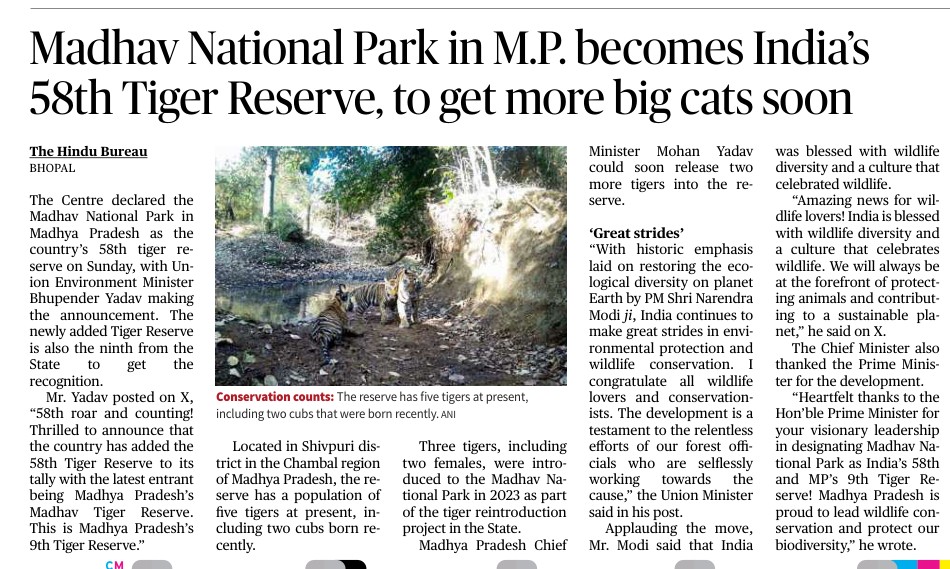
From an initial network of 9 reserves spanning 9,115 sq. km in 1973, India’s network has expanded to 58 Notified Tiger Reserves governed by the statutory authority NTCA (National Tiger Conservation Authority) under the Wildlife (Protection) Act, 1972.
📌 High-Yield Exam Pointers (Must Remember!)
- Total Tiger Reserves in India: 58 Notified Reserves.
- Tiger State of India: Madhya Pradesh (9 Tiger Reserves – Maximum in India).
- First Tiger Reserve: Jim Corbett, Uttarakhand (1973).
- Largest Tiger Reserve (Area): Nagarjunsagar-Srisailam (Andhra Pradesh & Telangana).
- Smallest Tiger Reserve (Core Area): Bor Tiger Reserve (Maharashtra, ~138 sq. km).
- Only Tiger Reserve in Jharkhand: Palamau Tiger Reserve (Latehar & Garhwa districts).
- Only Mangrove Habitat in the World: Sundarbans (West Bengal).
- Only Natural Habitat for Melanistic (Black) Tigers: Similipal (Odisha).
- International TX2 Award Winners in India: Pilibhit (UP), Sathyamangalam (TN), and Manas (Assam) for doubling tiger counts.
1. Legal Architecture: Core vs. Buffer Zone Strategy
Under Section 38V of the Wildlife (Protection) Act, 1972 (amended in 2006), each Tiger Reserve follows a two-tier zoning approach:
A. Core / Critical Tiger Habitat
Inviolate zones notified by state governments. Human exploitation, commercial forestry, cattle grazing, and construction are strictly forbidden to ensure undisturbed wild breeding.
B. Peripheral / Buffer Zone
Surrounds core habitats. Aims for a coexistence model where regulated eco-tourism, traditional agricultural access, and sustainable livelihood generation are permitted.
📖 Quick Link for Jharkhand GS: Read our curated notes on
Top 10 Ancient Forts of Jharkhand: History & Architecture
2. Special Notes: Palamau Tiger Reserve (Jharkhand)
Essential points frequently asked in JPSC & JSSC Examinations:
- Pioneer of Tiger Census: The world’s first formal tiger census based on the pugmark tracking method was executed here in 1932 by J.W. Nicholson (DFO, Palamau).
- Inception: Notified in 1973–74 as one of the 9 founder reserves under Project Tiger.
- District Location: Spread over Latehar and Garhwa districts in the western Chota Nagpur Plateau.
- Protected Components: Comprises Betla National Park (notified 1986) and Palamau Wildlife Sanctuary.
- Rivers Draining PTR: North Koel, Auranga, and Burha rivers.
- Historical Monument: Houses the 16th-century twin Palamau Forts constructed during the Chero dynasty (associated with King Medini Ray).
- Corridor Link: Connects east-west with Chhattisgarh’s Guru Ghasidas National Park and MP’s Sanjay-Dubri Tiger Reserve.
3. State-Wise Complete Directory of Tiger Reserves
| No. | Tiger Reserve | State | Key Geological & Wildlife Features |
|---|---|---|---|
| 1 | Nagarjunsagar-Srisailam | Andhra Pradesh | Largest Tiger Reserve in India by total area; spreads across Nallamala Hills; Krishna river basin. |
| 2 | Namdapha | Arunachal Pradesh | Highest altitude reserve; home to 4 big cats: Tiger, Leopard, Clouded Leopard, Snow Leopard. |
| 3 | Pakke (Pakhui) | Arunachal Pradesh | Famous for Hornbill Nest Adoption Program; drained by Kameng River. |
| 4 | Kamlang | Arunachal Pradesh | Located in Lohit district; houses Glow Lake; named after Kamlang River. |
| 5 | Manas | Assam | UNESCO World Heritage Site; contiguous with Bhutan’s Royal Manas; Pygmy Hog & Golden Langur habitat. |
| 6 | Nameri | Assam | Foothills of Eastern Himalayas; home to endangered White-winged Wood Duck. |
| 7 | Kaziranga | Assam | UNESCO World Heritage Site; world’s highest density of One-horned Rhinos and high tiger density. |
| 8 | Orang | Assam | Northern bank of Brahmaputra River; termed “Mini Kaziranga”. |
| 9 | Valmiki | Bihar | Only tiger reserve in Bihar; located in West Champaran; contiguous with Nepal’s Chitwan NP. |
| 10 | Indravati | Chhattisgarh | Located in Bijapur district; key sanctuary for endangered Wild Water Buffalo. |
| 11 | Udanti-Sitanadi | Chhattisgarh | Located in Gariaband/Dhamtari; dedicated wild buffalo conservation center. |
| 12 | Achanakmar | Chhattisgarh | Part of Achanakmar-Amarkantak Biosphere Reserve; links Maikal Range landscapes. |
| 13 | Guru Ghasidas–Tamor Pingla | Chhattisgarh | Crucial corridor connecting MP (Sanjay-Dubri/Bandhavgarh) and Jharkhand (Palamau). |
| 14 | Palamau | Jharkhand | Original 9 Project Tiger reserve (1973); site of first 1932 pugmark census; North Koel river basin. |
| 15 | Bandipur | Karnataka | Part of Nilgiri Biosphere Reserve; contiguous with Nagarahole, Wayanad & Mudumalai. |
| 16 | Bhadra | Karnataka | Chikkamagaluru district; recognized for model voluntary village relocation. |
| 17 | Nagarahole (Rajiv Gandhi) | Karnataka | Kabini reservoir separates it from Bandipur; high predator-prey density. |
| 18 | Kali (Dandeli-Anshi) | Karnataka | Uttara Kannada rainforests; notable for Black Panther sightings; Kali river. |
| 19 | BRT (Biligiri Ranganatha) | Karnataka | Ecological link between Western and Eastern Ghats; Soliga indigenous tribe. |
| 20 | Periyar | Kerala | Surrounds Periyar Lake; recognized for tribal participatory eco-development. |
| 21 | Parambikulam | Kerala | Palakkad district; home to ancient 450-year-old Kannimara Teak tree. |
| 22 | Kanha | Madhya Pradesh | Saved Hardground Barasingha; official mascot: Bhoorsingh the Barasingha. |
| 23 | Pench (MP) | Madhya Pradesh | Inspiration for Kipling’s Jungle Book; straddles MP and Maharashtra border. |
| 24 | Bandhavgarh | Madhya Pradesh | High tiger density; ancestral land of White Tigers; ancient Bandhavgarh Fort. |
| 25 | Panna | Madhya Pradesh | Benchmark tiger reintroduction success after 2009; Ken-Betwa river basin. |
| 26 | Satpura | Madhya Pradesh | Hoshangabad; Pachmarhi biosphere area; walking safaris permitted. |
| 27 | Sanjay-Dubri | Madhya Pradesh | Forms contiguous wildlife corridor with Guru Ghasidas NP in Chhattisgarh. |
| 28 | Veerangana Durgavati | Madhya Pradesh | Sagar/Damoh; notified to absorb tiger overflow from Ken-Betwa project. |
| 29 | Ratapani | Madhya Pradesh | Raisen/Sehore; houses UNESCO Bhimbetka Rock Shelters; Vindhyan range. |
| 30 | Madhav | Madhya Pradesh | Shivpuri; links Ranthambore (Rajasthan) with Kuno and Panna landscapes. |
| 31 | Melghat | Maharashtra | Original 1973 reserve; Satpura range; prime habitat for rare Forest Owlet. |
| 32 | Tadoba-Andhari | Maharashtra | Chandrapur; oldest park in Maharashtra; known as Jewel of Vidarbha. |
| 33 | Pench (Maharashtra) | Maharashtra | Nagpur district; designated India’s first Dark Sky Park. |
| 34 | Sahyadri | Maharashtra | Combines Koyna Wildlife Sanctuary and Chandoli National Park in Western Ghats. |
| 35 | Navegaon-Nagzira | Maharashtra | Vital central corridor linking Tadoba, Kanha, and Pench landscapes. |
| 36 | Bor | Maharashtra | Wardha; Smallest Tiger Reserve in India by core area (~138 sq. km). |
| 37 | Dampa | Mizoram | Along Indo-Bangladesh border; rugged terrain; rich Clouded Leopard population. |
| 38 | Similipal | Odisha | UNESCO Biosphere Reserve; Only natural home to pseudo-melanistic (black) tigers. |
| 39 | Satkosia | Odisha | Mahanadi River gorge; prominent Gharial & Mugger freshwater conservation. |
| 40 | Ranthambore | Rajasthan | Confluence of Aravalli & Vindhyas; famous for historical Ranthambore Fort. |
| 41 | Sariska | Rajasthan | Alwar district; pioneer of aerial tiger translocation (from Ranthambore in 2008). |
| 42 | Mukundara Hills | Rajasthan | Chambal basin; accommodates tiger dispersal from Ranthambore. |
| 43 | Ramgarh Vishdhari | Rajasthan | Bundi district; key corridor linking Ranthambore and Mukundara Hills. |
| 44 | Dholpur-Karauli | Rajasthan | Chambal ravines landscape; connects tiger corridors into Madhya Pradesh. |
| 45 | Kalakad-Mundanthurai | Tamil Nadu | Part of Agasthyamalai Biosphere Reserve; watershed for Thamirabarani River. |
| 46 | Mudumalai | Tamil Nadu | Tri-junction of TN, Kerala & Karnataka; houses ancient Theppakadu Elephant Camp. |
| 47 | Anamalai | Tamil Nadu | Anamalai Hills; prime habitat for Lion-tailed Macaque and Nilgiri Tahr. |
| 48 | Sathyamangalam | Tamil Nadu | Gateway between Western & Eastern Ghats; international TX2 Award winner. |
| 49 | Srivilliputhur-Megamalai | Tamil Nadu | Protects Vaigai River catchment and Grizzled Giant Squirrel habitat. |
| 50 | Kawal | Telangana | Godavari river catchment; corridor to Maharashtra’s Tadoba reserve. |
| 51 | Amrabad | Telangana | Nallamala Hills; second largest core area; home to indigenous Chenchu tribe. |
| 52 | Dudhwa | Uttar Pradesh | Terai Arc; comprises Dudhwa NP, Kishanpur WLS, Katarniaghat WLS; swamp deer refuge. |
| 53 | Pilibhit | Uttar Pradesh | Origin of Gomti River (Gomat Taal); first recipient of the global TX2 Award. |
| 54 | Ranipur | Uttar Pradesh | Chitrakoot (Bundelkhand); dry deciduous habitat acting as conduit for Panna tigers. |
| 55 | Amangarh (Buffer) | Uttar Pradesh | Bijnor district; acts as a protective buffer zone for Jim Corbett National Park. |
| 56 | Jim Corbett | Uttarakhand | India’s first National Park (1936) & first Tiger Reserve (1973); Ramganga river. |
| 57 | Rajaji | Uttarakhand | Shivalik foothills; northernmost range limit for both tigers and Asian elephants. |
| 58 | Sundarbans | West Bengal | UNESCO World Heritage Site; world’s only mangrove tiger habitat; swimming tigers. |
| 59 | Buxa | West Bengal | Alipurduar (Dooars); transboundary corridor linked to Bhutan’s Royal Manas. |
4. Tech Terms in News (Environment GS Paper)
- M-STrIPES: Monitoring System for Tigers: Intensive Protection & Ecological Status. A GIS/GPS-enabled mobile app introduced by NTCA for real-time field patrolling.
- CaTRAT: Camera Trap Data Repository and Analysis Tool. Software that catalogs and matches unique tiger stripe profiles like fingerprints.
- TX2 Goal: A commitment adopted at the 2010 St. Petersburg Tiger Summit to double the world’s wild tigers.
— JharkhandiBaba.in Study Cell